





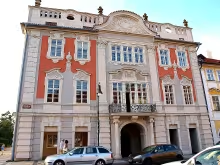
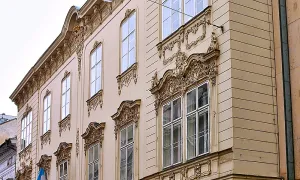
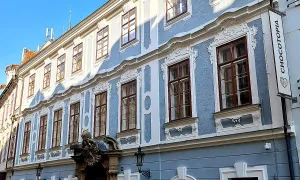
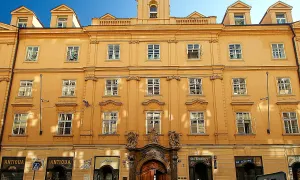
Kučerův palác, also known as U zlaté lodi or U Demartinů, is a Rococo palace located on Pohořelec Street in Prague 1's historic Hradčany district. This architectural gem has been protected as a cultural monument since 1958 and features an ornate Rococo facade completed between 1764 and 1769. Originally three narrow Gothic townhouses, the site underwent significant transformations over centuries, reflecting various styles from Renaissance to Baroque. Its rich history and distinctive style make it a notable landmark in Prague.
The origins of Kučerův palác trace back to three Gothic townhouses that once occupied its location. These structures were initially transformed into a Renaissance building known as "U zlaté lodi." The first significant Baroque transformation occurred around 1723 for Count of Vrbna, marking the beginning of its evolution into a grand palace. Subsequently, Karel Kučera commissioned the Rococo facade between 1764 and 1769, an architectural style characterized by ornate decoration and elegant forms, often attributed to Jan Josef Wirch. This period was part of the Baroque era when Bohemia, under the Habsburg Monarchy, experienced significant cultural and architectural growth influenced by European trends.
Architecturally, Kučerův palác showcases a transition from Gothic origins through Renaissance modifications to its current Rococo style. The late 19th-century urban development led to further changes, including the demolition of parts of the structure during the creation of Keplerova ulice. Despite these alterations, the palace retains its distinctive late Baroque appearance, thanks to comprehensive reconstruction efforts in the 1990s.
Ownership and administration of Kučerův palác have seen several notable figures over time. Initially transformed for Count of Vrbna, it later came into the possession of Emanuel z Kolowrat. Karel Kučera, a significant figure in its history, was responsible for the Rococo facade's completion. Following him, the Demartin family became prominent owners in the late 19th century. The palace also served as the headquarters for Státní památková správa from the 1950s until 1989 and has since been home to VERMONT Holding a.s.
Throughout its history, Kučerův palác has witnessed various transformations and events that have shaped its current form. The first Baroque transformation around 1723 set the stage for its evolution into a Rococo palace under Karel Kučera's direction. The late 19th-century urban development led to structural changes, while the 1990s reconstruction restored its late Baroque appearance.
Today, Kučerův palác stands as a testament to Prague's architectural heritage and cultural history. Located near landmarks such as Prague Castle and the Church of Our Lady before Týn, it offers visitors a glimpse into the city's rich past. The palace is accessible to those interested in exploring Prague's historical architecture, making it a worthwhile visit for anyone intrigued by its storied past and elegant design.
Kučerův palác remains an integral part of Prague's cultural landscape, inviting visitors to appreciate its architectural beauty and historical significance. Its journey through various styles and ownerships reflects the dynamic history of the city itself, offering a unique window into the past for those who walk its halls today.
Historical milestones
- kolem 1723
- První barokní transformace pro hraběte z Vrbny.
- 1764-1769
- Výstavba rokokové fasády pod vedením Karla Kučery.
- 1958
- Ochrana jako kulturní památka.
- 19. století
- Urbanistický vývoj vedl k demolici části budovy.
- 1990
- Rekonstrukce obnovila pozdně barokní vzhled.
Architectural development
The site originally housed three Gothic townhouses, later transformed into a Renaissance building known as 'U zlaté lodi'. The first baroque transformation occurred around 1723. Karel Kučera commissioned the Rococo facade between 1764 and 1769, often attributed to Jan Josef Wirch. In the late 19th century, changes included demolishing parts of the structure during urban development.
Historical events
First baroque transformation around 1723 for Count of Vrbna.
Rococo facade completed by Karel Kučera between 1764 and 1769.
Reconstruction in the 1990s restored its late Baroque appearance.
Owners
Emanuel z Kolowrat
Karel Kučera (circa 1764–1769)
Demartin family (late 19th century onwards)
Points of interest
- Kučerův palác was originally three narrow Gothic townhouses before being transformed into a Renaissance building known as "U zlaté lodi," reflecting the architectural evolution of its site.
- The palace's Rococo facade, completed between 1764 and 1769, is often attributed to Jan Josef Wirch, showcasing the ornate decoration characteristic of the period influenced by European trends under the Habsburg Monarchy.
Guide
Show guide text
Welcome to Kučerův palác, a jewel nestled in the heart of Prague's historic Hradčany hill. As you stand here on Pohořelec Street, take a moment to absorb the elegance and grace that surrounds you. This Rococo palace, known also as U zlaté lodi or U Demartinů, is more than just an architectural marvel; it’s a tapestry woven with centuries of history.
Let's delve into its origins. Imagine this site around 1723 when three narrow Gothic townhouses stood here, each telling their own story. It was then that the first baroque transformation took place for Count Vrbna, setting the stage for what would become one of Prague’s most cherished landmarks. Fast forward to between 1764 and 1769, under the guidance of architect Karl Kučera, a stunning Rococo facade emerged, attributed to Jan Josef Wirch. This period marked a significant transformation, turning these modest structures into a grand palace that still captivates visitors today.
Now, as you gaze upon the palatial front, notice how it reflects the architectural evolution over centuries—from Gothic beginnings through Renaissance and Baroque influences. The Rococo style is particularly striking here, with its elegant curves and ornate detailing inviting admiration. This facade isn’t just a feast for the eyes; it’s a testament to the vision of those who shaped it.
The history of Kučerův palác is rich with intriguing stories and notable figures. Karl Kučera himself played a pivotal role in its development, his name forever linked to this architectural masterpiece. Emanuel z Kolowrat also has ties here, adding layers to the palace's storied past. These individuals were not just architects or patrons; they were visionaries who contributed to Prague’s cultural and historical landscape.
One fascinating aspect of Kučerův palác is its resilience through time. Despite urban development in the 19th century leading to parts of it being demolished, the essence of this structure endured. It wasn’t until 1990 that a meticulous reconstruction restored its late Baroque appearance, allowing us today to appreciate its full splendor.
As you stand here, let yourself be transported back through time, imagining the lives and stories that have unfolded within these walls. Kučerův palác is not just a building; it’s a living history book waiting to be explored.
I invite you now to continue your journey around this magnificent site. Every corner holds secrets of its past, every stone tells a story. As we conclude our audio guide, remember that the beauty of Kučerův palác lies in its ability to connect us with the rich tapestry of history that is Prague itself.
Thank you for joining me on this exploration. May your visit be filled with discovery and wonder. Farewell!
Tips for visitors
The best time to visit Kučerův palác is during the late spring or early fall when the weather is pleasant, allowing for a comfortable stroll through the historic Hradčany district. These seasons offer mild temperatures and vibrant natural scenery, enhancing your experience of the area's architectural beauty without the crowds typical of peak tourist months like summer.
Parking in Prague can be challenging due to limited spaces and high demand, especially near popular attractions. Public transportation is highly recommended for reaching Kučerův palác. The palace is accessible by tram lines that run through the city center, making it convenient to explore without worrying about parking. For those driving, it's advisable to park in designated areas further from the site and use public transit or walking for the final leg of your journey.
When visiting Kučerův palác, consider bringing comfortable walking shoes as you'll likely be exploring on foot. A light jacket is also recommended due to variable weather conditions. Additionally, carrying a water bottle can keep you hydrated during your visit, especially if you plan to explore nearby attractions and spend several hours in the area.
For photography enthusiasts, Kučerův palác offers picturesque opportunities with its Rococo architecture set against the backdrop of Prague's historic skyline. The best light for capturing the palace is typically during the golden hour—shortly after sunrise or before sunset—when the soft lighting accentuates the building’s intricate details and colors. Exploring from different angles around the Hradčany hill can also provide unique perspectives.
Nearby, within a 30-minute walk, you'll find Prague Castle, one of Europe's largest castle complexes with stunning views over the city. The Church of Our Lady before Týn is another notable site close by, known for its impressive Gothic architecture and historical significance. Both locations offer enriching experiences that complement your visit to Kučerův palác.
For families visiting with children, the area around Kučerův palác provides a mix of cultural exploration and leisure activities. The proximity to Prague Castle offers opportunities for educational tours suitable for young visitors, while nearby parks can serve as spots for relaxation or play. Engaging with interactive exhibits at local museums could also be an enjoyable way to spend time together.
Businesses nearby
Nearby
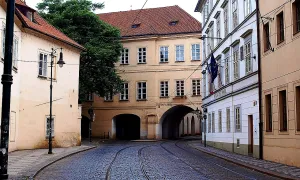
Kučerův palác is situated in Prague's historic Hradčany district, near landmarks such as Prague Castle and the Church of Our Lady before Týn. The area features a mix of medieval architecture and modern urban development.
Accommodation nearby
Trips and activities nearby
Guided tours, tickets and activities nearby from GetYourGuide
Search tours and activities →Themed route
Tematická výletní trasa: Historický Hradčany a Kučerův palác
1. Kučerův palác *Typ:* Palác *Proč stojí za návštěvu:* Kučerův palác, nacházející se v srdci historického Hradčanského okrsku, je skvělým příkladem barokní architektury a nabízí pohled na bohatou historii Prahy. Tento elegantní palác byl postaven pro hraběte Františka Antonína Šporka v 18. století a dnes slouží jako sídlo Ministerstva zahraničních věcí České republiky, což přidává k jeho historickému významu.
2. Kostel Panny Marie před Týnem *Typ:* Kostel *Proč stojí za návštěvu:* Nacházející se pouhých pár minut chůze od Kučerova paláce, je kostel Panna Marie před Týnem jedním z nejznámějších gotických chrámů v Praze. Jeho imponující věže a bohaté historie odrážejí duchovní i kulturní dědictví města, což ho činí klíčovým bodem pro každého cestujícího zájemce o historii.
3. Prague Castle *Typ:* Hrad *Proč stojí za návštěvu:* I když je to trochu vzdálenější, Prague Castle je nezbytným cílem pro každého navštěvujícího Hradčany. S jeho komplexní historií sahající až do 9. století, hrad poskytuje pohled na vývoj české architektury a politiky. Jeho bohatá sbírka uměleckých děl a krásná zahrada Střelecký ostrov dodávají tomuto míru další hloubku.
4. Královská věž *Typ:* Věž *Proč stojí za návštěvu:* Královská věž, nacházející se uvnitř Prague Castle, je nejstarším částí hradu a nabízí jedinečný pohled na Prahu. Její historie sahá do 9. století a sloužila jako obranné sídlo i jako vězeňská věž, což ji činí fascinujícím místem pro ty, kteří se zajímají o starobylou historii.
5. Hradčanské náměstí *Typ:* Náměstí *Proč stojí za návštěvu:* Hradčanské náměstí, nacházející se mezi Kučerovým palácem a Prague Castle, je centrem historických událostí a slavnostních akcí. Jeho krásná architektura a klidné prostředí nabízejí ideální místo pro odpočinek a refleksi nad bohatou minulostí, kterou obklopuje.
Tato trasa vám umožní prozkoumat nejen Kučerův palác, ale i další historické památky v okolí Hradčanského okrsku, což poskytne komplexní pohled na bohaté dědictví Prahy.
Seasonal recommendations
Spring: Visiting Kučerův palác during spring offers a delightful experience as the city of Prague awakens with vibrant colors and blossoming flowers. The natural beauty surrounding the palace is enhanced by longer daylight hours, making it an ideal time to explore both indoors and outdoors. While the weather can be unpredictable, layers are advisable to accommodate fluctuating temperatures. As the season marks the start of the tourist influx, visiting in the early morning or late afternoon can help avoid larger crowds, allowing for a more serene exploration of this historic site.
Summer: The summer months bring an energetic atmosphere to Kučerův palác, with Prague basking in long, warm days and extended evening hours. This is the peak tourist season, so expect bustling streets and popular attractions. To fully enjoy your visit without the crowds, consider arriving early or visiting during weekdays. Light, breathable clothing is recommended due to the heat, along with comfortable walking shoes for exploring the palace grounds. The vibrant city life and outdoor cafes add a lively backdrop to your visit.
Autumn: Autumn at Kučerův palác is characterized by stunning foliage that transforms the landscape into a picturesque setting of warm hues. The cooler temperatures make it an ideal time for leisurely strolls around the area, with fewer tourists compared to summer. Dressing in layers can help you stay comfortable as the weather transitions from mild days to chilly evenings. This season also offers a more intimate experience of Prague’s cultural offerings, allowing visitors to enjoy the palace and its surroundings at a relaxed pace.
Winter: Winter transforms Kučerův palác into a magical scene with snow-dusted architecture and festive decorations throughout Prague. The shorter daylight hours mean planning your visit during the day is essential to make the most of the limited light. Dress warmly in layers, including hats, gloves, and scarves, as temperatures can be quite cold. While some attractions may have reduced opening times, winter offers a unique charm with fewer crowds and an enchanting atmosphere that captures the essence of Prague’s historic beauty during the holiday season.
Visualizations and artistic views

Vizualizace jsou generovány umělou inteligencí a slouží jako inspirace.


Tips from visitors
No tips yet. Be the first!
Log in and add your tip.
Location on the map

Příběhy a pověsti
Legendy, pověsti a příběhy spjaté s touto památkou
Reviews and comments