






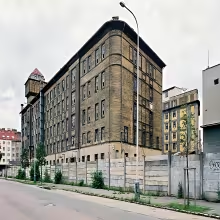
The Akciový parní mlýn, located in Prague's Holešovice district, is a historically significant industrial site originally built as a steam mill. Constructed between 1909 and 1910, it showcases early 20th-century functionalist architecture with streamlined forms and innovative materials like reinforced concrete. Initially serving as a flour milling facility, the complex played an important role in Prague's industrial landscape until its conversion into office spaces known today as Classic 7 Business Park.
The origin of Akciový parní mlýn dates back to August 1909 when it was established by the Akciová společnost mlýnů v Praze. This initiative arose due to the import of cheap grain from Hungary, prompting local millers like Vávra z Čerčan to seek competitive solutions. Its strategic location near a Holešovice dock facilitated efficient grain transport, highlighting its importance during an era marked by industrial growth and modernization within the Austro-Hungarian Empire.
Architecturally, Akciový parní mlýn was designed by Josef Vaňha and Bohumil Hypšman. The main mill building featured reinforced concrete construction with iron columns and wooden trusses supporting a six-story structure divided into three wings. A distinctive water tower equipped for firefighting purposes added to its functional design. Adjacent to the mill, an obilné silo was constructed using reinforced concrete, showcasing simpler façade designs compared to the main building.
Ownership of the site transitioned through several hands over time. Initially managed by Akciová společnost mlýnů v Praze until 1946, it then became part of Středočeské mlýny following nationalization decrees. In 1957, control shifted to Národní podnik Pražské pekárny a mlýny, which oversaw significant changes including electrification and reconfiguration in the 1960s. The site was later managed by Firma Ahema from 1991 until Balabenka s.r.o. acquired it in 1998.
Key events at Akciový parní mlýn include its commissioning in September 1910, during which it began operations with a daily capacity of milling 160 tons of wheat and 50 tons of rye. During World War I, the facility expanded to produce corn grits, adding a new dimension to its industrial capabilities. The site's historical significance was further cemented when it became part of Středočeské mlýny in 1946.
Today, Akciový parní mlýn has been transformed into Classic 7 Business Park following a re-conversion project between 2006 and 2008 by CMC Architects. The historical buildings were preserved while integrating modern office spaces, including new glass structures that complement the original architecture. This blend of history and contemporary design makes it an intriguing site for visitors interested in industrial heritage and architectural evolution.
The Akciový parní mlýn offers a unique glimpse into Prague's industrial past while serving as a functional part of its present urban landscape. Its historical significance, coupled with modern adaptations, invites exploration and appreciation from those keen to understand the city's development over time.
Historical milestones
- 1910
- The steam mill began operations.
- 1946
- The facility was nationalized as part of Středočeské mlýny.
Architectural development
The Akciový parní mlýn was constructed between 1909 and 1910 with a focus on functionalist design. The main mill building featured reinforced concrete construction and innovative structural elements, including iron columns and wooden trusses. A distinctive feature was the water tower equipped for firefighting purposes. Over time, the complex underwent significant changes, including electrification and reconfiguration in the 1960s.
Historical events
The steam mill was commissioned in response to the import of cheap grain from Hungary, and it began operations in September 1910.
During World War I, the facility expanded its capabilities to include a corn grits production line with a capacity of 10 tons per day.
In 1946, following nationalization decrees, the mill became part of Středočeské mlýny, integrating it into a larger network of state-owned mills.
Owners
Akciová společnost mlýnů v Praze (1909-1946)
Středočeské mlýny (1946-1957)
Národní podnik Pražské pekárny a mlýny (1957-1991)
Firma Ahema (1991-1998)
Balabenka s.r.o. (since 1998)
Points of interest
- The Akciový parní mlýn was initially established as a response to the import of cheap grain from Hungary, illustrating how international trade pressures can drive local industrial innovation.
- During World War I, the mill expanded its operations to include the production of corn grits, demonstrating its adaptability and contribution to wartime food supply efforts.
- The water tower at Akciový parní mlýn was not only a functional part of the building's design but also served as a firefighting resource, highlighting early 20th-century concerns about industrial safety.
Guide
Show guide text
Welcome to the Akciový parní mlýn in Prague's vibrant Holešovice district! As you stand before this iconic industrial site, take a moment to soak in its imposing presence—a testament to early 20th-century innovation and resilience.
This steam mill, conceived by architects Josef Vaňha and Bohumil Hypšman, began operations in 1910. Its creation was driven by the need to counteract the influx of cheap Hungarian grain, showcasing how international trade pressures can spur local industrial ingenuity. As you look around, imagine the bustling activity that once filled this space as it served as a crucial flour milling facility.
Now, let's delve into its architectural charm. The Akciový parní mlýn is an exquisite example of functionalist architecture, characterized by streamlined forms and innovative use of materials like reinforced concrete—a pioneering choice at the time. As you walk around, take note of how these elements combine to create a structure that is both practical and aesthetically pleasing.
In 1946, this facility was nationalized as part of Středočeské mlýny, marking another significant chapter in its history. While specific historical figures connected to the mill remain largely unknown, the stories embedded within its walls speak volumes about the era's industrial spirit and community impact.
One fascinating aspect of this site is how it adapted during World War I by expanding operations to include corn grits production—a testament to its versatility and strategic importance. This adaptation not only highlights the mill's resilience but also underscores the broader historical context in which it operated.
As we conclude our brief exploration, consider delving deeper into the stories that make this site unique. There is much more to discover about its past and how it has shaped the present. Thank you for joining us on this journey through history at the Akciový parní mlýn. We hope your visit inspires further curiosity and appreciation for Prague's rich industrial heritage.
Tips for visitors
The best time to visit the Akciový parní mlýn is during late spring or early autumn when the weather is pleasant, allowing for a comfortable exploration of both the mill and its surroundings. This period often coincides with fewer tourists, providing a more serene experience. The historical significance of the site can be better appreciated in these months as you walk through the area without the distraction of large crowds.
Parking near the Akciový parní mlýn is limited due to the urban development surrounding it. Visitors are encouraged to use public transportation, which offers convenient access to the site. The proximity of Prague's tram and bus lines makes it easy to reach Holešovice without needing a car. For those who prefer driving, checking local parking apps or websites for nearby options can be helpful.
When visiting the Akciový parní mlýn, consider bringing comfortable walking shoes as you'll likely explore on foot. A camera is recommended to capture the architectural details of the mill and its industrial heritage. Since photography enthusiasts will find several interesting angles, especially during golden hour when the light enhances the textures of the building, planning your visit around this time can yield stunning photographs.
For families with children, the Akciový parní mlýn offers an educational outing into Prague's industrial history. While there are no specific child-friendly attractions at the site itself, the surrounding area provides opportunities for a leisurely walk or a picnic in one of the nearby parks. Explaining the historical context can make it engaging for kids interested in how industries operated in the past.
Within 30 minutes from the Akciový parní mlýn, visitors can explore other attractions such as the historic dock that once facilitated grain transport. This site provides insight into the logistical operations of the mill and offers a glimpse into Prague's industrial past. The proximity to modern urban development also allows for an interesting contrast between historical and contemporary architecture.
Businesses nearby
Nearby
Situated in Prague's Holešovice district, the site is surrounded by modern urban development. Historically, it was near a dock that facilitated grain transport, contributing to its strategic location for milling operations.
Accommodation nearby
Trips and activities nearby
Guided tours, tickets and activities nearby from GetYourGuide
Search tours and activities →Themed route
Tematická výletní trasa: Akciový parní mlýn a okolí Holešovice
1. Akciový parní mlýn (Mlýn) *Proč stojí za návštěvu:* Tento historický akciový parní mlýn je jedinečnou památkou průmyslové éry, která představuje technologický pokrok v oblasti mlýnských operací. Nabízí návštěvníkům pohled na architekturu a inženýrské řešení z počátku 20. století, což je fascinující pro všechny zájemce o průmyslovou historii.
2. Stará přístavní čtvrť Holešovice *Proč stojí za návštěvu:* Tato oblast byla dříve klíčovým místem pro transport obilí, což podpořilo rozvoj mlýna. Návštěvníci si mohou užít moderního urbanistického prostředí s historickými prvky a pochopit důležitost této lokality pro průmyslové operace v minulosti.
3. Pražská tržnice *Proč stojí za návštěvu:* Ačkoli není přímo spojena s mlýnem, Pražská tržnice je důležitou součástí Holešovic a poskytuje kontext k pochopení ekonomického významu oblasti. Je to živý místní trh, který nabízí širokou škálu produktů a atmosféru staré Prahy.
4. Přístavní nábřeží Holešovice *Proč stojí za návštěvu:* Toto místo bylo důležitým spojením pro transport zboží, včetně obilí do mlýna. Návštěvníci mohou si užít pohled na Vltavu a pochopit historické dopravní role přístavu v rozvoji Holešovic.
5. Holešovický zámek *Proč stojí za návštěvu:* I když není součástí okolí uvedeného v úkolu, je to nedaleké historické místo, které poskytuje vhled do kulturní a architektonické minulosti oblasti. Zámek se nachází na krásném návrší nad Vltavou a nabízí výhledy i poznatky o historii Holešovic.
Tato trasa kombinuje průmyslovou historii s moderním urbanistickým prostředím, což poskytuje návštěvníkům komplexní pohled na vývoj oblasti Holešovice.
Seasonal recommendations
Spring: Visiting the Akciový parní mlýn during spring offers a unique experience as nature begins to awaken around Holešovice, Prague. The gentle warmth of the season brings out vibrant colors in blooming flowers and lush greenery that frame the historical mill beautifully. As daylight extends, the natural light enhances the architectural details of the site, creating an inviting atmosphere for exploration. During this time, it's wise to dress in layers; mornings can be cool while afternoons grow warmer. While attendance is generally moderate compared to peak summer months, arriving early ensures a more leisurely visit before any potential increase in visitors as the day progresses.
Summer: The Akciový parní mlýn in summer exudes an energetic atmosphere under the bright sun and long days. This season attracts numerous tourists to Prague's vibrant neighborhoods, including Holešovice, making it one of the busiest times for visiting historical sites. To avoid large crowds, consider arriving early in the morning or later in the afternoon when the heat subsides. Light, breathable clothing is recommended due to warm temperatures and high humidity levels. The summer ambiance adds a lively backdrop to your visit, allowing you to enjoy outdoor spaces around the mill while soaking up the sun.
Autumn: Autumn at the Akciový parní mlýn offers a serene and picturesque setting as the foliage transforms into rich hues of red, orange, and yellow. The cooler temperatures create a comfortable environment for walking through the historic site without the summer crowds. This period is ideal for photography enthusiasts eager to capture the mill against the backdrop of autumnal landscapes. Layered clothing is advisable due to fluctuating temperatures throughout the day, with mornings often being crisp and evenings chilly. As visitor numbers decrease compared to summer, it's an excellent time to enjoy a more relaxed visit.
Winter: Visiting the Akciový parní mlýn in winter provides a magical experience as Prague transforms under a blanket of snow, offering a stark yet beautiful contrast with the mill’s industrial architecture. The shorter days mean that daylight hours are limited, so plan your visit during midday to fully appreciate the site's features. Winter attire is essential; warm clothing, including coats and hats, will ensure comfort in the cold weather. While the site may have fewer visitors than other seasons due to its reduced operating hours, this also means a quieter experience where you can take in the unique winter atmosphere at your own pace.
Visualizations and artistic views


Vizualizace jsou generovány umělou inteligencí a slouží jako inspirace.


Tips from visitors
No tips yet. Be the first!
Log in and add your tip.
Reviews and comments