





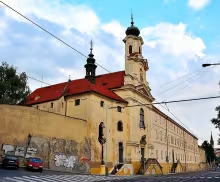
Kostel Panny Marie u alžbětinek is a single-nave, late Baroque church in Prague's New Town. It sits near Na Slupi Street and close to Charles University's Botanical Garden. Designed by Kilián Ignác Dientzenhofer as part of an Elizabethan convent and hospital complex, it was consecrated in 1725. This architectural gem is notable for its Baroque style and historical significance, reflecting Bohemia's cultural flourishing under Habsburg rule during the early 18th century.
The church's origins are linked to Prague's New Town history. In 1719, the Elizabethan order, led by Countess L. Schönkirchová, established a hospital in Prague. The site where Kostel Panny Marie u alžbětinek now stands was previously occupied by a home for emeritus priests with a chapel until it moved in 1705. This relocation allowed the Elizabethan order to acquire the land and begin constructing their convent complex, including the church, which was completed swiftly due to funding secured by Countess Schönkirchová and other noblewomen.
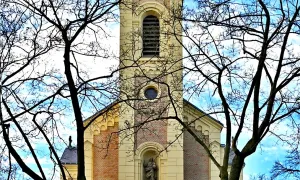
Architecturally, Kostel Panny Marie u alžbětinek exemplifies Baroque design. The two-story western façade features a portal adorned with the coat of arms of Marie Markéta z Valdštejna, a significant donor. Above this is a casement window and a robust Doric entablature topped by a triangular pediment. A baroque gable with a sculpture of the Virgin Mary in its niche crowns the structure, covering the lower part of the small tower without a lantern. The church's interior was likely designed by Kilián Ignác Dientzenhofer himself, featuring a unified composition. Noteworthy artworks include an image of Our Lady of Sorrows on the main altar and paintings on side altars attributed to Siard Nosecký from 1723. Additionally, the church houses late Gothic woodcarvings and impressive sculptures by Ignáce Františka Platzera.
Throughout its history, Kostel Panny Marie u alžbětinek has seen several additions that enhanced its architectural complexity. In 1762, a chapel dedicated to Saint Tecla was attached to the left side of the façade. Further modifications included a new pulpit in 1771 and an altar in 1779. By the early 20th century, as street levels were lowered, K. Hübschmann added an entrance staircase to accommodate changes.
The church stands on land that once belonged to Augustin, an apothecary who cultivated medicinal plants around 1382. This historical connection adds another layer of intrigue to the site's rich past. The area surrounding the church blends historical and modern architecture, offering visitors a glimpse into Prague's evolving urban landscape.
Today, Kostel Panny Marie u alžbětinek remains an accessible cultural monument, protected as part of the Czech Republic's heritage. Its architectural beauty and historical significance make it a worthwhile visit for anyone interested in Baroque art and history. The church not only serves as a testament to the artistic achievements of its time but also invites visitors to explore the rich tapestry of Prague's past.
Historical milestones
- 1719
- Elizabethan order established a hospital in Prague.
- 1705
- Emeritus priests' home relocated, allowing land acquisition for church.
- 1724
- Construction of Kostel Panny Marie u alžbětinek began.
- 1725
- Church consecrated, completed by Kilián Ignác Dientzenhofer.
- 1762
- Chapel dedicated to Saint Tecla added to church façade.
- 1771
- New pulpit installed in the church.
Architectural development
Construction began rapidly after funding was secured by Countess L. Schönkirchová and other noblewomen, leading to its completion in just a year. The church features a two-story western façade with a portal bearing the coat of arms of Marie Markéta z Valdštejna, a major donor. Over time, additional structures like a chapel dedicated to Saint Tecla were added, enhancing its architectural complexity.
Historical events
- 1719
- The Elizabethan order, led by Countess L. Schönkirchová, established a hospital in Prague.
- 1725
- The church was consecrated and became an integral part of the convent complex.
Points of interest
- The church stands on land that was once the site of a home for retired priests with its own chapel before being acquired by the Elizabethan order in 1705. This historical layer adds depth to the church's origin story.
- Countess L. Schönkirchová played a crucial role not only as a leader of the Elizabethan order but also as a key financier who secured funds for the construction of the church, highlighting her significant influence on its development.
Guide
Show guide text
Welcome to the historic site of Kostel Panny Marie u alžbětinek, a gem nestled in Prague's vibrant Nové Město district. As you stand here on Na Slupi Street, take a moment to absorb the serene beauty that unfolds before your eyes. This single-nave church is an exquisite example of late Baroque architecture, its façade adorned with a modest tower that beckons you into its storied past.
The origins of this sacred place are deeply rooted in Prague's history. In 1705, land was acquired for the construction of what would become Kostel Panny Marie u alžbětinek, following the relocation of an emeritus priests' home that once occupied the site. This area, rich with spiritual significance, saw a new chapter unfold when the Elizabethan order established a hospital in Prague in 1719. The church itself began to rise from these foundations in 1724 under the visionary guidance of Kilián Ignác Dientzenhofer, an architect whose genius would leave an indelible mark on this sacred space.
As you gaze upon the façade, notice how its Baroque elegance is both understated and captivating. The church was consecrated in 1725, a testament to Dientzenhofer's architectural prowess. Later, in 1762, a chapel dedicated to Saint Tecla was added, enhancing the church's spiritual allure. In 1771, a new pulpit found its place within these hallowed walls, further enriching the church's liturgical life.
The history of this site is intertwined with notable figures who played pivotal roles in its development. Countess L. Schönkirchová, for instance, was instrumental not only as a leader but also as a visionary whose contributions helped shape this ecclesiastical landmark into what it is today.
There's an intriguing layer to the church's history: before becoming part of the Elizabethan convent and hospital complex, this land served as a home for retired priests with its own chapel. This historical tapestry adds depth to your understanding as you explore the site.
As we conclude our journey through Kostel Panny Marie u alžbětinek, I invite you to linger a little longer, perhaps wandering around its perimeter or simply pausing to reflect on the stories and souls that have passed through this sacred space. Whether you're drawn by architectural beauty, historical intrigue, or spiritual solace, there's always more to discover here. Thank you for joining me today; may your visit inspire curiosity and wonder as you continue exploring Prague's rich tapestry of history and culture.
Businesses nearby
Nearby
The church is situated near the southern edge of Prague's New Town, close to the Botanical Garden of Charles University. The area features a mix of historical and modern architecture.
Accommodation nearby
Trips and activities nearby
Guided tours, tickets and activities nearby from GetYourGuide
Search tours and activities →Themed route
Tematická Výletní Trasa: Kostel Panny Marie u Alžbětinek a Okolí
1. Kostel Panny Marie u Alžbětinek - *Typ:* Historická památka, kostel - *Proč stojí za návštěvu:* Tento barokní kostel je známý svou bohatou historií a architekturou. Postaven v roce 1679 jako klášterní kaple pro řeholnice alžbětinky, je dnes přístupný veřejnosti a nabízí pohled na krásné interiéry s bohatým dekorativním uměním.
2. Botanická zahrada Univerzity Karlovy - *Typ:* Botanická zahrada - *Proč stojí za návštěvu:* Nachází se v okolí kostela a nabízí pohled na rozmanitou flóru, která je organizována podle systému Linneje. Je to ideální místo pro relaxaci mezi prozkoumáním historických památek a poskytuje klidný prostor plný přírodní krásy.
3. Klášter Alžbětinek - *Typ:* Historické klášterní budovy - *Proč stojí za návštěvu:* Klášter, který byl součástí kostela Panny Marie u alžbětinek, je důležitou historickou památkou s bohatou minulostí. Dnes slouží jako sídlo několika institucí Univerzity Karlovy a nabízí pohled na části klášterního komplexu, které jsou otevřené pro veřejnost.
4. Náměstí Republiky - *Typ:* Náměstí - *Proč stojí za návštěvu:* Toto centrální náměstí v Praze je známé svým historickým a architektonickým významem. Je to místo, kde se setkávají dějiny a současnost, s impozantními budovami jako Národní divadlo a památník Thámům.
5. Kostel svatého Mikuláše - *Typ:* Historický kostel - *Proč stojí za návštěvu:* Nacházející se blízko Botanické zahrady, tento gotický kostel je jedním z nejstarších v Praze. Jeho historie sahá až do 13. století a nabízí pohled na starobylou architekturu a bohatou historii.
Tato trasa kombinuje historické památky s přírodním klidem Botanické zahrady, což vytváří harmonický mix pro každého návštěvníka.
Seasonal recommendations
Spring: Visiting the Church of Our Lady before Týn during spring offers a unique experience as nature begins to awaken around this historic site in Prague's New Town. The blooming flowers and fresh greenery create a picturesque setting, enhancing the church’s architectural beauty with natural light that softly illuminates its intricate details. This season is ideal for photography enthusiasts looking to capture the interplay between the church and vibrant surroundings. As temperatures begin to rise, visitors should opt for comfortable layers—light jackets or sweaters are recommended in case of cooler mornings or evenings. While spring attracts a moderate number of tourists, it's best to visit early in the day to avoid larger crowds that gather later.
Summer: The summer months at the Church of Our Lady before Týn bring long daylight hours and warm weather, creating an inviting atmosphere for exploration. The sun casts dramatic shadows across the church’s façade, highlighting its Gothic features and adding a sense of grandeur to your visit. This is also a peak tourist season in Prague, so it's advisable to arrive early in the morning to enjoy a quieter experience before the crowds build up. Light, breathable clothing is essential for comfort during this time, along with sun protection such as hats or sunglasses. The church’s grounds are particularly pleasant in summer, offering shaded areas where visitors can relax and reflect.
Autumn: Autumn at the Church of Our Lady before Týn presents a stunning display of changing foliage that frames the historic structure in warm hues of reds, oranges, and yellows. This season provides a unique opportunity to witness the church against the backdrop of Prague’s vibrant autumnal landscape, with softer lighting conditions enhancing its architectural details. While temperatures begin to cool, visitors should dress in layers to accommodate varying weather throughout the day. Autumn is generally less crowded than summer, making it an excellent time for those seeking a more tranquil visit. The cooler climate also adds to the charm of exploring Prague’s historic sites during this season.
Winter: Visiting the Church of Our Lady before Týn in winter offers a serene and magical experience as snow gently blankets the city, creating a picturesque setting around this iconic landmark. The church is beautifully illuminated at night, casting a warm glow that contrasts with the cool tones of the snowy surroundings. Winter attire should include warm clothing, including coats, hats, gloves, and scarves to stay comfortable in lower temperatures. It's important to note that some services or events might have adjusted schedules due to shorter daylight hours, so checking opening times is advisable. Despite potential crowds during festive periods, winter provides a unique atmosphere for appreciating the church’s beauty amidst Prague’s enchanting winter landscape.
Visualizations and artistic views

Vizualizace jsou generovány umělou inteligencí a slouží jako inspirace.

Tips from visitors
No tips yet. Be the first!
Log in and add your tip.



Reviews and comments