





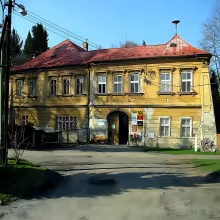
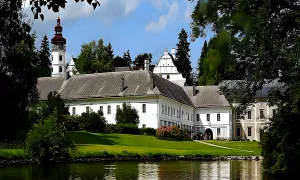
Bílá Lhota Castle is a classicist estate with Empire style elements, located in the village of Bílá Lhota within Olomoucký kraj, Czech Republic. This historical monument stands on the foothills of Zábřežské vrchoviny and has evolved significantly since its first mention in 1356. Originally a fortress, it transformed into a Renaissance castle and later underwent baroque modifications before attaining its current classicist form in the early 19th century. The estate is particularly notable for its arboretum established by Quid Riedl in the early 20th century, featuring over 300 species of trees.
The origins of Bílá Lhota Castle trace back to the late Middle Ages when it was first mentioned as part of an estate held by Zdislav z Řimic. Initially a fortress, its exact construction date is not documented, but historical records indicate that by 1437, a known structure existed under Ješek ze Lhoty's ownership. Over time, the site transitioned through various hands, reflecting broader political and social changes in Bohemia, which was part of the Holy Roman Empire during its initial construction and later came under Habsburg rule.
Architecturally, Bílá Lhota Castle has seen several transformations. The original fortress likely gave way to a new structure by the late Middle Ages. By the end of the 16th century, it had been transformed into a Renaissance castle. Subsequent baroque renovations in the 18th century significantly altered its appearance before it assumed its current classicist and Empire style architecture in the early 19th century.
Ownership of Bílá Lhota Castle has changed hands multiple times throughout history. After Zdislav z Řimic, notable owners included Jiří z Poděbrad, who transferred the estate to Karel z Vlašimi in 1464. Erazimus Bítovský ze Slavíkovic and his descendants likely constructed a new structure during their tenure. The castle later became associated with Mikuláš Kobylka z Kobylího and Jan Záviše Bítovský ze Slavíkovic, who oversaw its transformation into a Renaissance-style edifice in the late 16th century. Markvart Hochberg z Hennersdorfu purchased it in 1720 for 31,580 gold coins, followed by Jan Maxmilián Žižka. The Speil family owned it from 1792 to 1840, during which Conradin Kreutzer composed his opera "Nacht in Granada" while staying at the castle. Finally, the Riedl family held ownership until 1945.
Key events in Bílá Lhota Castle's history include its transformation into a Renaissance castle and later baroque modifications. The establishment of an arboretum by Quid Riedl in the early 20th century marked another significant development, turning the estate's park into a notable dendrological area with over 300 species of trees.
Today, Bílá Lhota Castle serves as a multifunctional site for the local community. The castle is now a single-story, four-winged building housing an obecní úřad (municipal office), post office, library, and health center. Its park, once part of the zámek's grounds, has been transformed into Arboretum Bílá Lhota, which was opened to the public in 1968 as a National Nature Monument. The arboretum features both domestic and rare European and exotic trees from regions such as North America, Japan, China, and Asia Minor.
Bílá Lhota Castle offers visitors a glimpse into its rich history through its architectural evolution and the diverse species within its arboretum. Its significance lies not only in its historical transformations but also in its current role as a community hub. Visitors are invited to explore this unique blend of cultural heritage and natural beauty, making it a worthwhile destination for those interested in both history and nature.
Historical milestones
- 1356
- First mention of Bílá Lhota as part of Zdislav z Řimic's estate.
- 1464
- Transfer of the estate to Jiří z Poděbrad, then to Karel z Vlašimi.
- 1720
- Purchase by Markvart Hochberg z Hennersdorfu for 31,580 gold coins.
- 1926-1945
- Establishment of the arboretum by Quid Riedl.
Architectural development
The original fortress was likely replaced with a new structure in the late Middle Ages. By the end of the 16th century, it had been transformed into a Renaissance castle. In the 18th century, it underwent baroque renovations that significantly altered its appearance. The current classicist and Empire style architecture dates back to the early 19th century.
Historical events
First mentioned in 1356 as part of the estate held by Zdislav z Řimic.
Reconstruction into a Renaissance castle in the late 16th century.
Establishment of an arboretum by Quid Riedl in the early 20th century.
Owners
Zdislav z Řimic (1356)
Jiří z Poděbrad (1464) -> Karel z Vlašimi
Erazimus Bítovský ze Slavíkovic
Mikuláš Kobylka z Kobylího
Jan Záviše Bítovský ze Slavíkovic
Markvart Hochberg z Hennersdorfu (1720)
Jan Maxmilián Žižka
Speil family (1792-1840)
Riedl family (1869-1945)
Points of interest
- The castle's transformation into a Renaissance structure was overseen by Jan Záviše Bítovský ze Slavíkovic in the late 16th century, reflecting the influence of Italian Renaissance architecture on Bohemian nobility.
- Composer Conradin Kreutzer composed his opera "Nacht in Granada" while staying at Bílá Lhota Castle during the Speil family's ownership, highlighting its role as a cultural hub and inspiration for artists.
Guide
Show guide text
Welcome to the historical site of Bílá Lhota Castle, a remarkable testament to architectural evolution nestled in the foothills of Zábřežské vrchoviny near the village of Bílá Lhota. As you stand here, take a moment to absorb the grandeur before you—a classicist estate with subtle touches of the Empire style that whisper tales from centuries past.
The story of this castle begins in 1356 when it was first mentioned as part of Zdislav z Řimic's estate. Over time, Bílá Lhota became a coveted possession among nobility. In 1464, it transitioned to the hands of Jiří z Poděbrad and later Karel z Vlašimi, marking its significance in regional history.
As you gaze upon the structure, notice how it has transformed over time. Originally built as a fortress during the late Middle Ages, Bílá Lhota underwent significant changes. In the late 16th century, Jan Záviše Bítovský ze Slavíkovic spearheaded its transformation into a Renaissance building, infusing Italian architectural influences that were fashionable among Bohemian nobility.
Moving through time, in 1720, Markvart Hochberg z Hennersdorfu acquired the estate for 31,580 gold coins. This period marked another phase of development, eventually leading to baroque modifications that further enriched its aesthetic appeal.
One of the castle's most intriguing aspects is its arboretum, established between 1926 and 1945 by Quid Riedl. As you wander through this lush collection, imagine the meticulous care taken to cultivate such diversity in plant life—a living testament to the estate’s enduring legacy.
Among the notable figures associated with Bílá Lhota is Conradin Kreutzer, whose creative spirit was inspired here as he composed his opera "Nacht in Granada." Such stories add a layer of cultural richness to this historic site.
As you continue exploring, let your curiosity guide you through its grounds. Each step reveals more about the lives and times that shaped Bílá Lhota Castle. We invite you to delve deeper into its history and enjoy every moment of discovery.
Thank you for joining us on this journey through time at Bílá Lhota Castle. May your visit be both enlightening and inspiring.
Tips for visitors
The best time to visit Bílá Lhota Castle is during late spring or early autumn when the weather is mild, and the surrounding Zábřežské vrchoviny foothills are lush with greenery. This period also offers pleasant temperatures for exploring the castle grounds and enjoying a walk through the arboretum. Additionally, visiting in these months allows you to appreciate the historical garden remnants without the summer crowds or winter chill.
Parking at Bílá Lhota Castle is generally available nearby, but it's advisable to check ahead if there are any restrictions or specific parking areas designated for visitors. Public transportation options can also be used; however, details on bus routes and schedules should be verified through a local transport service provider or an online search tool to ensure the most current information.
When planning your visit, consider bringing comfortable walking shoes as you'll likely explore both the castle grounds and its surrounding natural beauty. A camera is recommended for capturing the picturesque views of the estate and arboretum. Don't forget to bring a hat, sunscreen, or an umbrella depending on the weather forecast, along with water and snacks if planning a longer stay.
For photography enthusiasts, early morning or late afternoon provides the best light conditions at Bílá Lhota Castle, casting soft shadows that enhance the classicist architecture and the lush greenery of the arboretum. The historical garden remnants offer unique spots for capturing the blend of nature and history. Families with children will find the castle's expansive grounds inviting for a leisurely stroll or a picnic.
Nearby attractions within 30 minutes include exploring more of the Zábřežské vrchoviny foothills, which are ideal for hiking and enjoying panoramic views of the region. The arboretum itself is a must-visit for nature lovers interested in learning about the diverse tree species cultivated there.
Businesses nearby
Do you run a restaurant, accommodation, shop, museum, rental, wellness or other visitor service near this monument? Show yourself directly to the people heading to it — this is how they will see you in the app and on the web:
Nearby
Bílá Lhota Castle is surrounded by the Zábřežské vrchoviny foothills and features an arboretum with over 300 species of trees. The area includes remnants of a historical garden dating back to the 15th century.
Accommodation nearby
Trips and activities nearby
Guided tours, tickets and activities nearby from GetYourGuide
Search tours and activities →Themed route
Tematická výletní trasa zámek Bílá Lhota
1. Zámek Bílá Lhota (zámek) Začněte svou cestu u samotného zámku Bílá Lhota, který je krásně umístěn v obci stejnojmenné. Zámek je známý svou historickou architekturou a působivým nádvořím. Je to ideální místo pro pochopení historie regionu, zejména s ohledem na jeho významnou minulost.
2. Arboretum Bílá Lhota (arborétum) Přibližně 10 minut chůze od zámku se nachází arboretum, které je součástí zámeckého parku. Toto místo nabízí návštěvníkům příležitost prozkoumat více než 300 různých druhů stromů. Arboretum je skvělým místem pro milovníky botaniky a těch, kteří mají rádi klidnou chvíli v přírodě.
3. Zbytky historického zahrady (historická zahrada) V okolí arboretumu jsou zachovány i některé prvky starší, historické zahrady datované do 15. století. Tyto zbytky poskytují jedinečný pohled na zahradní umění a praxe minulých dob. Prozkoumání těchto zbytků může být fascinujícím zážitkem pro historiky i amatérské botaniky.
4. Nádvoří zámku (nádvoří) Po prozkoumání okolních zahrad se vraťte na nádvoří zámku, kde můžete podrobněji prohlédnout jeho architektonické prvky a možná i některé výstavy nebo expozice. Nádvoří slouží jako centrální bod, kde se mohou setkat historie a příroda regionu.
Tato trasa nabízí komplexní pohled na zámek Bílá Lhota i jeho okolí, kombinující historické a přírodní prvky do jednoho harmonického výletu.
Seasonal recommendations
Spring: Visiting Bílá Lhota Castle during spring offers a picturesque setting as nature awakens with vibrant blooms and lush greenery enveloping the historic site. The gentle warmth of the season enhances the castle's beauty, making it an ideal time for photography enthusiasts to capture stunning landscapes. As daylight extends into the evening, visitors can enjoy the soft glow of natural light accentuating architectural details. It is advisable to dress in layers as temperatures can fluctuate, and while crowds are moderate, arriving early ensures a more tranquil experience.
Summer: Summer at Bílá Lhota Castle is characterized by long days filled with sunshine, making it perfect for exploring the castle grounds and enjoying outdoor activities. The lush gardens come alive with color, providing a vibrant backdrop to the historic architecture. This season attracts more visitors due to its popularity as a travel time, so planning ahead is crucial—arriving early can help avoid peak crowds. Comfortable walking shoes and light clothing are recommended, along with sun protection for those spending extended periods outside.
Autumn: Autumn transforms Bílá Lhota Castle into an enchanting landscape of warm hues, with the foliage offering a stunning contrast to the castle's stone structures. The cooler temperatures create a serene atmosphere ideal for leisurely exploration and enjoying seasonal activities like apple picking nearby. While visitor numbers begin to dwindle as the season progresses, it remains important to check opening hours, which may be reduced in preparation for winter. Layered clothing is recommended to adapt to changing weather conditions throughout the day.
Winter: Winter at Bílá Lhota Castle brings a magical atmosphere with snow potentially blanketing the grounds, creating a fairy-tale-like setting that enhances its historic charm. The shorter days mean visiting earlier in the day is wise to fully experience the castle's features before closing time. Although fewer visitors are present, it's important to dress warmly and be prepared for potential closures due to extreme weather conditions. Winter offers a unique opportunity to appreciate the castle's architecture against the stark beauty of its surroundings.
Visualizations and artistic views

Vizualizace jsou generovány umělou inteligencí a slouží jako inspirace.


Tips from visitors
No tips yet. Be the first!
Log in and add your tip.
Location on the map


Příběhy a pověsti
Legendy, pověsti a příběhy spjaté s touto památkou
Reviews and comments