





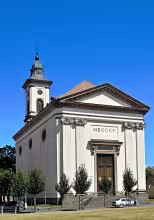
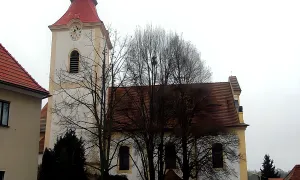
Kostel Vzkříšení Páně in Terezín is a Roman Catholic parish church located at the eastern edge of the main square, now known as Československé armády. Built between 1805 and 1810, this Empire-style structure originally functioned as a military garrison church. Its distinctive spire, reaching 56 meters, marks it as an important landmark in Terezín. The church has been protected as a cultural monument since 1964, highlighting its historical and architectural significance.
The origins of Kostel Vzkříšení Páně date back to the early 19th century when Bohemia was part of the Habsburg Monarchy. During this era, Europe saw significant military and architectural developments influenced by the Napoleonic Wars. The church was commissioned as a garrison church for military personnel, reflecting Terezín's strategic importance at that time. Designed by Ing. Heinrich Hatzinger and hrabě Jules d’Andriès, its construction spanned from 1805 to 1810.
Architecturally, Kostel Vzkříšení Páně exemplifies the Empire style, characterized by its stately and symmetrical design. The church features a single nave that transitions into a slightly apsidal east end. Its main portal is notable for high-carved doors and an imposing façade designed to open during festive services, allowing it to face the central square. Inside, the interior maintains a modest yet impressive aesthetic with architectural elements from its time of construction. The church houses significant artworks, including a painting of Christ’s Resurrection by Professor Josef Bergler, a prominent figure in Prague's art scene.
Throughout its history, Kostel Vzkříšení Páně has undergone several changes and restorations. A notable event was the installation of new varhany in 1898 by the krnovská firm Rieger-Kloss, replacing an earlier instrument by Anton Rusche. The church underwent a significant restoration between 1994 and 1997, culminating in its reconsecration on November 8, 1997, by Litoměřice bishop Josef Koukl. This restoration included the installation of a new křišťálový lustr from Novoborské sklárny, donated by the city of Terezín.
Today, Kostel Vzkříšení Páně stands as both a historical and cultural landmark in Terezín. Its protected status since 1964 underscores its importance to local heritage. Visitors can appreciate not only its architectural beauty but also its rich history, reflected in elements like the commemorative plaque on its north exterior wall, which honors Emperor Joseph II's order to build the fortress in honor of his mother, Maria Theresa. The church remains accessible and continues to serve as a place of worship and reflection.
Kostel Vzkříšení Páně is more than just an architectural marvel; it is a testament to Terezín’s historical narrative and cultural evolution. Its preservation allows visitors to connect with the past while appreciating its enduring beauty and significance. A visit to this monument offers a unique glimpse into the rich tapestry of history that defines Terezín, making it a must-see for anyone interested in exploring the region's heritage.
Historical milestones
- 1805
- The church was founded in this year.
- 1964
- It became a protected cultural monument.
Architectural development
Kostel Vzkříšení Páně was built in the Empire style, characterized by its stately and symmetrical design. The church's main portal features high-carved doors and an imposing façade that opens during festive services to face the central square. Its interior is modest yet impressive, with architectural elements from the time of construction. A significant restoration took place between 1994 and 1997.
Historical events
Construction of the church took place from 1805 to 1810.
The church was designated a cultural monument in 1964.
Points of interest
- The church's spire, standing at 56 meters, is one of the tallest structures in Terezín and serves as a prominent navigational landmark for both locals and visitors.
- Originally commissioned during the Napoleonic Wars, the church reflects the military significance of Terezín at the time, serving not just religious purposes but also as a garrison chapel for troops stationed there.
Guide
Show guide text
Welcome! You are standing in front of the Church of the Resurrection of the Lord in Terezín, one of the most significant historical landmarks in the entire city. The church, located on the eastern side of the main square known as Československé armády, dominates this part of town. Take a look at its façade and notice the tall 56-meter-high tower, which is one of the tallest structures in Terezín and serves as a prominent landmark for both locals and visitors.
Let's delve into history to find out why the church was built. The Church of the Resurrection of the Lord was founded in 1805 during the Napoleonic Wars. At that time, Terezín played an important role as a military fortification, and thus this military chapel was constructed. Now, over two centuries later, it is a significant cultural monument protected by law.
The interior space of the church is spacious and exudes a tranquil atmosphere. Notice the simple, neoclassical architecture that characterizes this period. The church has a single nave with a slightly apsidal eastern end. Now let's focus on the tower, which truly dominates the church. The tower stands 56 meters high and can be seen from much of the city. Its remarkable design adds to the overall appearance of the church.
Terezín has a rich history, and the Church of the Resurrection of the Lord is just one of many interesting sites. If you are interested in other historical figures and stories associated with this place, I can tell you that there are many intriguing things to discover here.
A highlight of the church is its remarkable tower, which is not only tall but also very impressive. The tower is also known as one of the most distinctive landmarks in Terezín. So what are you waiting for? Explore the Church of the Resurrection of the Lord and discover its beauty and history.
Businesses nearby
Do you run a restaurant, accommodation, shop, museum, rental, wellness or other visitor service near this monument? Show yourself directly to the people heading to it — this is how they will see you in the app and on the web:
Accommodation nearby
Trips and activities nearby
Guided tours, tickets and activities nearby from GetYourGuide
Search tours and activities →Themed route
Terezín Sightseeing Route
1. Church of the Resurrection of the Lord (Terezín) - a must-visit for its unique architecture and history. 2. Terezín Barracks - worth visiting for their distinctive history and architecture, linked to the Theresienstadt concentration camp. 3. Stadium - worth visiting for its unique architecture and history, built in 1920. 4. Terezín Fortress - worth visiting for its unique history and architecture, constructed in the 18th century. 5. Terezín Foundation - worth visiting for its distinctive history and architecture, associated with the Theresienstadt concentration camp.
Seasonal recommendations
Jaro
Spring is the ideal time to visit the Church of the Resurrection of the Lord in Theresienstadt because nature around the church is in full bloom. The green trees and blooming flowers create a pleasant atmosphere that complements the beautiful architecture of the church. The lighting is natural, allowing visitors to fully enjoy the beauty of the surroundings. The best time to visit the church is from April to May when tourist crowds are smaller, giving visitors plenty of time for exploration.
Summer
In the summer season, the Church of the Resurrection of the Lord in Theresienstadt is very popular with tourists, so it's a good idea to arrive early to avoid the crowds. The lighting is natural and nature is in full bloom. The atmosphere is relaxed and pleasant, making it ideal for families with children. The best time to visit the church is from June to August when days are long and visitors have plenty of time for exploration.
Autumn
The autumn season is beautiful for visiting the Church of the Resurrection of the Lord in Theresienstadt because nature is in fall colors. Blooming trees and forests create a calm and romantic atmosphere. The lighting is natural, allowing visitors to fully enjoy the beauty of the surroundings. The best time to visit the church is from September to October when tourist crowds are smaller and visitors have plenty of time for exploration.
Winter
The winter season is ideal for visiting the Church of the Resurrection of the Lord in Theresienstadt if you enjoy peace and quiet. The lighting is artificial to prevent darkness for visitors. The atmosphere is calm and serene, perfect for those who prefer smaller crowds. The best time to visit the church is from December to January when opening hours are shorter and visitors have plenty of time for exploration. Don't forget to bring warm clothing to stay cozy.
Visualizations and artistic views

Vizualizace jsou generovány umělou inteligencí a slouží jako inspirace.

Tips from visitors
No tips yet. Be the first!
Log in and add your tip.
Location on the map


Příběhy a pověsti
Legendy, pověsti a příběhy spjaté s touto památkou
Reviews and comments