



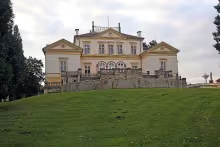
The Dobřenice Castle is a Neo-Classical castle situated in the village of Dobřenice, within the Hradec Králové District of the Czech Republic. It is a significant cultural monument and a dominant architectural feature of the village and its surroundings. The castle complex, including the adjacent agricultural courtyard and English park, is protected as a cultural monument.
Originally built in 1693 in the Baroque style by the Dobřenskými z Dobřenic family, the castle underwent significant changes. A fire in 1775 led to its rebuilding in 1865, followed by another restoration in 1865-1868 in the Neo-Classical style by Karl Weinrich. The castle's current appearance is the result of a major restoration project undertaken by the Loevenstein family in the 1990s. The castle's English park was designed by renowned European garden architect Eduard Petzold.
The castle has experienced multiple changes in ownership. It was initially built by the Dobřenskými z Dobřenic family in 1693, then rebuilt by Karl Weinrich in 1865-1868. In 1928, JUDr. Karel Loevenstein purchased the castle, restored it, and used it as a weekend residence. The castle was nationalized in 1948 and used as a breeding station for the Research and Breeding Institute for Sugar Beet. In 1993, the castle was returned to the Loevenstein family through restitution and underwent a major restoration project.
The castle's history is marked by several major reconstructions and rebuilds. It was damaged by fire during the peasant uprising in 1775 and again in 1860. The castle was rebuilt in the Neo-Classical style by Karl Weinrich in 1865-1868. The castle's current appearance is the result of a major restoration project undertaken by the Loevenstein family in the 1990s.
Today, the castle is open to the public and offers accommodation and event spaces. The castle is surrounded by a large English park and situated in the village of Dobřenice, within the Hradec Králové District. The castle is located in a rural area with rolling hills and forests. Visitors can explore the castle's interior, learn about its history, and enjoy the beautiful surroundings.
The Dobřenice Castle is a unique and fascinating monument offering a glimpse into the country's rich history and cultural heritage. Its Neo-Classical architecture, beautiful English park, and rich history make it a must-visit destination for anyone interested in history, architecture, or exploring the Czech countryside.
Historical milestones
- 1693
- The castle was built by the Dobřenskými z Dobřenic family
- 1775
- The castle was damaged by fire during the peasant uprising
- 1860
- The castle was damaged by fire again
- 1865
- The castle was rebuilt in the Neo-Classical style by Karl Weinrich
- 1868
- The castle was completed by Karl Weinrich
- 1928
- The castle was purchased by JUDr. Karel Loevenstein
- 1938
- JUDr.
Architectural development
The castle was originally built in 1693 in the Baroque style, but was rebuilt in 1865 after a fire in 1775. The castle was rebuilt again in 1865-1868 in the Neo-Classical style by Karl Weinrich. The castle's current appearance is the result of a major restoration project undertaken by the Loevenstein family in the 1990s.
Historical events
The castle was built in 1693 by the Dobřenskými z Dobřenic family, who later rebuilt it in 1865 after a fire in 1775. The castle was rebuilt again in 1865-1868 by Karl Weinrich. In 1928, the castle was purchased by JUDr. Karel Loevenstein, who restored it and used it as a weekend residence.
The castle was nationalized in 1948 and used as a breeding station for the Research and Breeding Institute for Sugar Beet. In 1993, the castle was returned to the Loevenstein family through restitution and underwent a major restoration project.
Owners
Dobřenskými z Dobřenic (1693), Karl Weinrich (1865-1868), JUDr. Karel Loevenstein (1928-1938)
Points of interest
– The castle's original Baroque architecture was significantly altered after a fire in 1775, which led to its rebuilding in the Neo-Classical style in 1865.
– The castle's English park was designed by renowned European garden architect Eduard Petzold, who is also known for designing parks in other European countries.
– The castle was used as a breeding station for the Research and Breeding Institute for Sugar Beet after it was nationalized in 1948.
Guide
Show guide text
Welcome, and thank you for joining me at this remarkable spot. You are standing in front of the Dobřenice Castle, a proud Neo‑Classical landmark that dominates the village of Dobřenice and its surrounding countryside. Take a moment to breathe in the quiet of the early morning, the gentle rustle of leaves in the nearby English park, and the faint scent of stone and old timber. The castle’s façade greets you with its balanced proportions and restrained elegance, a testament to the architectural ideals of the 19th‑century revival.
Let’s step back and look at the broader picture. The original structure was erected in 1693 by the Dobřenskými z Dobřenic family, a lineage that had long held sway in this part of the Hradec Králové District. The castle was conceived as a manor house, a place of comfort and status for a family that had earned its name from the village itself. Its early years were marked by the rhythms of rural life, the quiet bustle of estate management, and the occasional gathering of local nobles.
But history is rarely a straight line. In 1775, a peasant uprising swept through the region, and the castle did not escape the turmoil. A fire broke out, consuming much of the original Baroque structure that had stood for over a century. The flames left a scar on the building’s legacy, but they also set the stage for a new chapter. The fire’s aftermath was a period of rebuilding, though the castle’s original Baroque features were largely lost. The ashes of the old gave way to a new vision: a Neo‑Classical design that would carry the castle into the modern era.
Fast forward to the mid‑19th century. In 1860, another fire struck the castle, a cruel reminder that the building’s past was still very much alive. Yet, this time, the owners were determined to restore the castle with a fresh architectural language. Enter Karl Weinrich, a prominent architect of the time, who was commissioned to rebuild the castle in the Neo‑Classical style. By 1865, the first phase of his work was complete, and by 1868 the castle stood fully restored, its new façade a harmonious blend of symmetry, columns, and understated ornamentation. The reconstruction was not merely a repair; it was a rebirth, a statement that the castle would endure.
In 1928, the castle changed hands once more, this time to JUDr. Karel Loevenstein, a distinguished jurist whose stewardship added another layer to the castle’s rich tapestry. Loevenstein’s ownership marked a period of preservation and appreciation, ensuring that the castle remained a cultural monument and a living part of the community.
Now let’s focus on what you see in front of you. The façade is the most striking element. Notice the orderly arrangement of windows, the subtle use of pilasters that give the building a sense of verticality, and the modest pediment that crowns the central entrance. The stonework is smooth, with a light, almost airy quality that reflects the Neo‑Classical penchant for clarity and proportion. While the original Baroque details are gone, the new design carries an elegance that feels both timeless and rooted in its era.
Move a little closer, and you’ll notice the attention to detail that Karl Weinrich brought to the reconstruction. The window frames are evenly spaced, each one a small rectangle that echoes the building’s overall symmetry. The entrance itself is framed by a modest portico, supported by slender columns that give the impression of a gentle embrace. The roofline is simple, with a subtle cornice that runs along the eaves, hinting at the classical orders without overstatement.
Beyond the castle’s walls lies the agricultural courtyard, a functional space that once supported the estate’s daily operations. The courtyard’s layout is straightforward, with a clear path that leads from the main entrance to the heart of the estate. It’s a reminder that the castle was not just a residence but a hub of activity, where the rhythms of farming and domestic life intertwined.
And then there’s the English park, a verdant expanse that stretches beyond the castle’s immediate surroundings. Designed by the renowned European garden architect Eduard
Tips for visitors
{'nadpis': 'Best time to visit', 'text': 'The best time to visit Dobřenice Castle is during spring and summer when the English park is in full bloom and the weather is pleasant. Avoid visiting during peak winter months when the park may be closed due to snow and ice.'}
{'nadpis': 'Parking and transport', 'text': 'The castle is accessible by car, and there is a large parking lot available near the entrance. You can also use public transportation, but be sure to check the current schedule in advance.'}
{'nadpis': 'What to bring', 'text': "Bring comfortable shoes for walking, as you will need to explore the castle and its surroundings. It's also a good idea to bring a camera to capture the beautiful views and architecture."}
{'nadpis': 'Photography', 'text': "The best spots for photography are around the castle's facade and in the English park. The golden hour, just before sunset, is ideal for capturing the castle's beauty. Be respectful of other visitors and avoid taking photos inside the castle."}
{'nadpis': 'What to see nearby', 'text': 'If you have time, consider visiting the nearby village of Dobřenice, which offers a charming atmosphere and traditional Czech cuisine. You can also explore the rolling hills and forests surrounding the castle.'}
{'nadpis': 'Tips for families with children', 'text': 'The castle is stroller-friendly, and there are plenty of areas for kids to run around and explore. However, be aware that some areas of the castle may be off-limits to children due to preservation or safety concerns.'}
Businesses nearby
Do you run a restaurant, accommodation, shop, museum, rental, wellness or other visitor service near this monument? Show yourself directly to the people heading to it — this is how they will see you in the app and on the web:
Nearby
The castle is surrounded by a large English park and is located in the village of Dobřenice, in the Hradec Králové District. The castle is situated in a rural area with rolling hills and forests.
Accommodation nearby
Visualizations and artistic views

Vizualizace jsou generovány umělou inteligencí a slouží jako inspirace.


Tips from visitors
No tips yet. Be the first!
Log in and add your tip.


Reviews and comments