





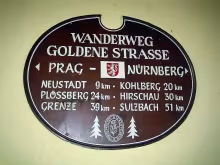
The Norimberk Road, also known as the Golden Road or Via Carolina, was a significant historical route connecting Bohemia to the Holy Roman Empire. It linked Norimberg to Prague and served as a major trade route. The road's importance grew after the establishment of the cities of Bamberg and Norimberg, which became a major commercial center in the Upper Palatinate.
The road's origins date back to the 8th century, although its exact route and usage during this period are unclear. Its significance grew in the 12th and 13th centuries, as the traditional west-east connection between Bohemia and the Holy Roman Empire was transformed. The Old Regensburg Road was supplemented and partially absorbed by the new route, connecting Norimberg and Prague.
The road's architecture and artistic form are not well-documented. However, it is known to have passed through the Bohemian Forest, a dense forest with many villages and natural features. Milestones and navigational aids likely marked the road, but the exact nature of these features is unknown.
The road was owned and administered by various entities, including the Holy Roman Empire and the Kingdom of Bohemia. Charles IV, King of Bohemia, played a significant role in the road's development, particularly in the 15th century. He closed the road due to its use by the Leuchtenbergs, a powerful noble family in the region.
The road was used by the Hussites in the Battle of Tachov in 1427, and it was reopened in 1602 after a new route was built through Rozvadov. The road facilitated trade and cultural exchange between Bohemia and the Holy Roman Empire, enabling the exchange of goods and ideas between the two regions.
Today, the Norimberk Road is a significant historical site, offering a glimpse into the region's rich past. Although the road is no longer a major thoroughfare, its legacy lives on in the many villages and towns it once connected. Visitors can still explore the remnants of the road and learn about its history and significance.
The Norimberk Road is a testament to the importance of trade and cultural exchange in the medieval period. Its legacy continues to fascinate historians and tourists, offering a unique glimpse into the region's complex past. Visitors are invited to explore this historic site and learn more about its significance in the history of Bohemia and the Holy Roman Empire.
Historical milestones
- 1115
- The road passed through the area of the present-day Rozvadov, where a Benedictine monastery was founded by Vladislav I.
- 1121
- The Romanesque castle of Přimda was built on the Přimda hill, controlling the border forest and the possible passage.
- 1427
- The road was used by the Hussites in the Battle of Tachov.
- 1602
- The road was reopened after a new route was built through Rozvadov.
Historical events
The road was used by the Hussites in the Battle of Tachov in 1427.
The road was closed by Charles IV in the 15th century due to its use by the Leuchtenbergs.
The road was reopened in 1602 after a new route was built through Rozvadov.
Points of interest
– The Norimberk Road was also known as the Golden Road or Via Carolina, reflecting its importance as a significant historical route connecting Bohemia to the Holy Roman Empire.
– The road's significance grew after the establishment of the cities of Bamberg and Norimberg, which became a major commercial center in the Upper Palatinate, highlighting the economic importance of the route.
Guide
Show guide text
Welcome to one of the most significant historical routes in Europe - the Norimberk Trail, also known as the Golden Way or Via Carolina. You are standing before one of the oldest and most famous roads in the Czech lands, which connected Bohemia with the Holy Roman Empire.
Let's delve into history and discover why this route was so important. It originated in the 11th century when a Benedictine monastery was founded in Rožnov by Vladislav I. Subsequently, a Romanesque castle was built on Přimda to control the border and possible passage.
Notice that the trail passes through this valley leading to the historical castle. It is a beautiful place where you can feel the atmosphere of the past.
This route was also important during the Hussite Wars, when it was used by the Hussites in the Battle of Tachov. And in 1602, the trail was reopened after the construction of a new road through Rožnov.
Now let's reflect on why the Norimberk Trail was so significant. It was an important trade and communication route that connected Bohemia with the Holy Roman Empire. That is why it is said to be the Golden Way.
Come walk this beautiful trail and explore its stunning details. Here you can feel the history and atmosphere of this important route. And who knows, maybe you'll want to travel back in time to see what it looked like when this road was truly golden.
Thank you for stopping by the Norimberk Trail. I hope you learned something new and that you will want to travel back in time to explore more historical landmarks.
Tips for visitors
The best time to visit the Norimberk Road is during the spring and summer months when the weather is mild and the scenery is lush. This is also the best time for photography, as the sunlight is soft and the wildflowers are in bloom.
To get to the Norimberk Road, you can park your car in the designated parking lot near the starting point of the trail. Alternatively, you can take public transportation to the nearby village and walk to the trailhead.
It's a good idea to bring comfortable hiking shoes, as the trail can be steep and uneven in some areas. You should also bring plenty of water and snacks, as there are no amenities along the way.
The best spots for photography are near the old castles and ruins along the route. The light is best in the early morning or late afternoon, when the sun is low in the sky.
If you're visiting with children, there are several playgrounds and picnic areas along the way where you can take a break and let them run around. You can also consider bringing a picnic lunch and enjoying it at one of the scenic overlooks.
Businesses nearby
Do you run a restaurant, accommodation, shop, museum, rental, wellness or other visitor service near this monument? Show yourself directly to the people heading to it — this is how they will see you in the app and on the web:
Nearby
The road passed through the Bohemian Forest, a dense forest with many villages and natural features.
Accommodation nearby
Themed route
Norimberská cesta (stezka)
1. _The Bohemian Forest_ - typ: přírodní rezervace, proč stojí za návštěvu: Prochází tudy Norimberská cesta, která byla důležitou obchodní stezkou v historii. 2. _Železná brána_ - typ: historická brána, proč stojí za návštěvu: Je jednou z posledních dochovaných částí středověké opevnění Norimberku a nabízí pohled na město a jeho okolí. 3. _Nürnberger Burg_ - typ: hrad, proč stojí za návštěvu: Hrad, který byl sídlem bavorských vévodů a později císařů Svaté říše římské, nabízí pohled na město a jeho historii.
Seasonal recommendations
Jaro
Spring is the ideal time to visit the Nuremberg Trail. The atmosphere is calm and nature is full of life and color. Forests are in full bloom, and trees are covered with leaves. Lighting is natural; sunlight illuminates historical buildings, creating a pleasant ambiance. We recommend visiting the Nuremberg Trail in the morning or late afternoon to avoid crowds and enjoy the sights in peace.
Summer
In summer, the Nuremberg Trail is one of the most visited places in Nuremberg. During peak season, there are many tourists eager to see historical buildings and stroll along the trail. We recommend arriving early to avoid crowds and enjoy the sites in tranquility. Lighting is natural; sunlight illuminates historical buildings, creating a pleasant ambiance. Don't forget to wear a sun hat and sunglasses.
Autumn
Fall is a beautiful season to visit the Nuremberg Trail. The atmosphere is calm, and nature is full of colors. Forests are covered with leaves, and trees display their full spectrum of hues. Lighting is natural; sunlight illuminates historical buildings, creating a pleasant ambiance. We recommend visiting the Nuremberg Trail in the morning or late afternoon to avoid crowds and enjoy the sights in peace. Don't forget to wear warm clothing, as temperatures may drop.
Winter
Winter is a quiet season to visit the Nuremberg Trail. The atmosphere is calm, and nature is covered with snow. Lighting is artificial due to limited sunlight. We recommend visiting the Nuremberg Trail in early morning or late afternoon hours to avoid crowds and enjoy the sights in peace. Don't forget to wear warm clothing and shoes suitable for cold weather. Some parts of the trail may be closed due to snow, so it's a good idea to check opening times beforehand.
Tips from visitors
No tips yet. Be the first!
Log in and add your tip.
Reviews and comments