






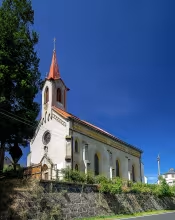
The Church of Saint Michael the Archangel in Dolní Poustevna is a Roman Catholic parish church located near the town center on a slope by the main road. Constructed between 1854 and 1855, it exemplifies the Neo-Gothic style and forms a functional unit with an adjacent rectory. This church replaced an earlier baroque chapel dedicated to Saint John of Nepomuk, reflecting the evolving religious needs of the community.
Dolní Poustevna was established as a parish in 1852, marking its transition from being under the ecclesiastical jurisdiction of Sebnitz and Lobendav. The original chapel, built in 1767 and dedicated to Saint John of Nepomuk, served local spiritual needs until it became insufficient for the growing community. By 1845, this small baroque structure was expanded but still failed to meet Dolní Poustevna's demands. With Josef Václav Kindermann appointed as the first priest in 1852, the need for a larger church became evident. Construction of the new Neo-Gothic Church of Saint Michael the Archangel began in mid-August 1854 and was completed by September 1855. This transition marked a significant development in Dolní Poustevna's religious life.
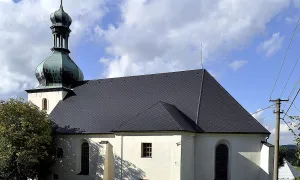
Architecturally, the church features a single-nave design with a five-sided apse, high windows with pointed arches, and decorative buttresses enhancing its Neo-Gothic aesthetic. Local figures like Karl Sieber supported construction by donating land for both the church and rectory, later contributing one of three new bells. The facade is relatively simple, with a gray color scheme accented by yellow ornamentation under window sills and eaves. Originally covered in slate, its roof was replaced with sheet metal during renovations at the end of the 20th century.
Throughout its history, the Church of Saint Michael the Archangel has seen various changes in ownership and administration. Initially serving as a parish church for Dolní Poustevna, it underwent significant renovation in 1905 under parish priest Gustav Adolf Šelbický. This period saw the addition of stained glass windows in the presbytery and an hourglass mechanism by Bernhardt Zachariase from Leipzig. Despite these enhancements, the church remained largely unchanged until after World War II when it faced neglect during the communist regime. It was maintained through volunteer efforts, particularly from parishioners, with further renovations to its facade and roof occurring in the late 20th century.
The church has been a focal point for key events and curiosities throughout its history. Notably, the main altar was transferred from the original chapel to this new structure. The interior features Neo-Gothic wooden cross processions dating back to 1890, adding to its historical significance. In 1868, the original chapel was demolished and replaced by an iron cross with a statue of Christ, marking another pivotal moment in the site's history.
Today, the Church of Saint Michael the Archangel remains under the ownership of the Roman Catholic parish of Dolní Poustevna. Although it is not officially protected as a heritage site, it continues to serve its community through regular religious services and occasional cultural events. The church stands as a testament to the architectural and spiritual evolution of the area, inviting visitors to explore its rich history and serene atmosphere.
The Church of Saint Michael the Archangel offers a unique glimpse into the historical and cultural fabric of Dolní Poustevna. Its enduring presence and architectural beauty make it a worthwhile destination for those interested in exploring the region's religious heritage. Visitors are encouraged to experience this remarkable monument, which continues to play an integral role in the community's spiritual life.
Historical milestones
- 1855
- The church was consecrated by Bishop Augustin Bartoloměj Hille.
- 1905
- A major renovation took place under the initiative of parish priest Gustav Adolf Šelbický.
Architectural development
The church's construction began in mid-August 1854, completed the following year. It features a single-nave design with a five-sided apse, high windows with pointed arches, and decorative buttresses. The original slate roof was replaced by sheet metal during renovations at the end of the 20th century.
Historical events
In 1852, Dolní Poustevna was established as a parish with Josef Václav Kindermann appointed as its first priest.
The original chapel was demolished in 1868 and replaced by an iron cross featuring a statue of Christ.
Points of interest
- In 1868, the original chapel dedicated to Saint John of Nepomuk was replaced by an iron cross with a statue of Christ, symbolizing a shift in religious and cultural representation at the site.
- The church's main altar holds historical significance as it was transferred from the earlier baroque chapel, linking the new Neo-Gothic structure directly to its predecessor.
- Among the interior features are wooden cross processions dating back to 1890, showcasing the local craftsmanship of the period and adding a unique element to the church's Neo-Gothic style.
Guide
Show guide text
Welcome to the Church of Saint Michael the Archangel in Dolní Poustevna, a remarkable testament to faith and history nestled on a gentle slope near the town center. As you stand here, you can't help but be captivated by its Neo-Gothic architecture, a style that speaks volumes about the era it was built in. Constructed between 1854 and 1855, this church replaced an earlier baroque chapel dedicated to Saint John of Nepomuk, marking a significant shift in religious expression at this site.
The story of this church begins with its consecration by Bishop Augustin Bartoloměj Hille in 1855. It was built to meet the evolving spiritual needs of the community, replacing an older structure that had served for decades. The decision to adopt Neo-Gothic architecture reflects a broader trend of the time, seeking to connect with historical forms of sacred spaces while addressing contemporary worship needs.
As you look around, take in the harmonious relationship between the church and its adjacent rectory. Together, they form a functional unit that speaks to thoughtful planning and design. Although specific architects are not credited, their vision is evident in every detail, from the pointed arches to the intricate stonework that adorns the façade.
The history of this site is enriched by key figures such as Josef Václav Kindermann and Karl Sieber, whose contributions have left an indelible mark on its legacy. Their involvement underscores the church's importance not just as a place of worship but as a community landmark shaped by notable personalities.
In 1868, a poignant transformation occurred when the original chapel dedicated to Saint John of Nepomuk was replaced by an iron cross with a statue of Christ. This change symbolizes more than just architectural evolution; it represents a shift in religious and cultural representation at this site, inviting reflection on how sacred spaces adapt over time.
One cannot help but be drawn to the church's main altar, a piece with its own storied past. Transferred from the earlier baroque chapel, it serves as a tangible link between generations of worshippers, embodying continuity amidst change.
As you conclude your visit here at Dolní Poustevna, we invite you to linger in this space that bridges history and faith. Let yourself be enveloped by its atmosphere and perhaps ponder the stories embedded within these walls. Thank you for joining us on this journey through time and spirit. May your exploration of this historic site inspire a deeper appreciation for the layers of history it represents.
We hope this audio guide has enriched your experience, and we encourage you to continue exploring the wonders that Dolní Poustevna has to offer. Safe travels as you uncover more secrets hidden in its embrace.
Businesses nearby
Do you run a restaurant, accommodation, shop, museum, rental, wellness or other visitor service near this monument? Show yourself directly to the people heading to it — this is how they will see you in the app and on the web:
Accommodation nearby
Themed route
Tematická výletní trasa: Kostel svatého Michaela archanděla (Dolní Poustevna)
1. Kostel svatého Michaela archanděla (Dolní Poustevna) - Kostel Začněte svůj výlet u samotného kostela svatého Michaela archanděla, který je nejenom náboženskou památkou, ale také architektonickým dílem s bohatou historií. Jeho gotická stavba a významná umělecká vybavení činí z něj neodmyslitelnou součást kulturního dědictví Dolní Poustevny.
2. Nádvoří kostela - Historické místo Prozkoumejte okolní nádvoří kostela, kde můžete ocenit klidné prostředí a historický vzhled. Toto místo sloužilo jako duchovní centrum pro obyvatele Dolní Poustevny po staletí a nabízí jedinečný pohled na minulost této lokalitě.
3. Věž kostela - Architektonická památka Vyzvedněte se do věže kostela, která nese nejenom svůj architektonický vzhled, ale také pohled na celou Dolní Poustevnu. Tento vrcholový bod trasy nabízí nejenom historickou hodnotu, ale i impozantní panoramatický výhled.
4. Expozice kostela - Kulturní zážitek Navštivte interiérovou expozici kostela, kde můžete se dozvědět více o jeho historii a uměleckých detailech. Tato část trasy vám poskytne hlubší pochopení kulturního a náboženského významu kostela pro region.
5. Park u kostela - Klidný ústup Zavěšte svůj výlet v parku u kostela, kde můžete odpočinout a absorbovat klidné atmosféry okolí. Toto místo je ideální pro relaxaci po intenzivním objevování historických památek.
Tato trasa nabízí komplexní pohled na kostel svatého Michaela archanděla a jeho bezprostřední okolí, což vám umožní ocenit jak duchovní, tak kulturní hodnoty Dolní Poustevny.
Seasonal recommendations
Jaro: Návštěva Kostela svatého Michaela archanděla v Dolní Poustevně během jara nabízí jedinečné zážitky, kdy se příroda probouzí ze své zimní dovolené. Sluneční paprsky osvětlují starobylý kostel v jemném záření, které zdůrazňuje jeho architektonické detaily. Okolní lesnaté oblasti se začínají pokrývat kvetoucími stromy a keři, což vytváří romantickou atmosféru pro návštěvníky. V této sezóně je doporučeno přijít brzy ráno nebo později večer, abyste se vyhnuli počátečním dámům a užili si klidnou procházku kolem kostela. Oblečte si komfortní boty pro chůzi na trávníku a odolné oblečení, které vás chrání před možnými deštičkami.
Léto: Létě je Kostel svatého Michaela archanděla oblíbenou destinací pro návštěvníky hledající únik od letního žaru. Slunečné dny zesilují barevné střechy a fasády kostela, což vytváří ideální podmínky pro fotografii. Okolní příroda je plná kvetoucích polí a lesů, které nabízejí krásné pozadí pro klidné chodby nebo pikniky. Léto přitahuje větší davu návštěvníků, takže je vhodné navštívit kostel brzy ráno nebo večer, aby se vyhnuli vrcholovým hodinám. Odolné sluneční ochranné oblečení a dostatek pitné vody jsou klíčem k pohodlné návštěvě.
Podzim: Během podzimu se Kostel svatého Michaela archanděla proměňuje ve skutečně romantický útočiště, když listy stromů začnou měnit barvu a padají na zem. Střechy kostela se odleskují v zlatém světle slunce, což vytváří pohledy plné klidu a krásy. Atmosféra je mírně chladná s nádechem brzké zimy, což znamená kratší otevírací dobu pro kostel. Návštěvníci by měli přijít v čas, aby si užili klidné okamžiky, a obléknout se tepleji, zejména ke konci sezóny, kdy chladnější počasí začíná. Tato doba je také ideální pro milovníky přírody, kteří si užívají proměny v krajině.
Zima: Zimní návštěva Kostela svatého Michaela archanděla nabízí jedinečný pohled na historickou památku, kdy je osvětlena zevnitř a vytváří magickou atmosféru. Mrazivé počasí může přidat klid a tichost do okolního prostředí, což činí návštěvu ideální pro ty, kteří hledají únik od zábavných podzimních aktivit. V této sezóně je otevírací doba kostela obvykle kratší kvůli chladným teplotám, takže je důležité se informovat o aktuálních časech před návštěvou. Teplé oblečení, včetně klobouku a rukavic, je nezbytné pro pohodlný zážitek, stejně jako vhodné boty pro chůzi na mrazivých površích.
Visualizations and artistic views

Vizualizace jsou generovány umělou inteligencí a slouží jako inspirace.


Tips from visitors
No tips yet. Be the first!
Log in and add your tip.



Reviews and comments