





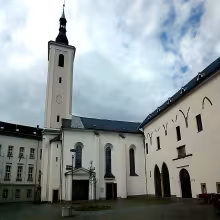
The Augustinian Monastery in Lanškroun is a historically significant site located in Lanškroun, Pardubický kraj, Czech Republic. Founded on 8th August 1371 as an Augustinian monastery for twelve canons, it was established with the support of Bishop Petr Wurst (Jelito) and dedicated to the Virgin Mary, Saint Nicholas, and Saint Catherine.
Originally built outside town walls, the monastery included a church honoring Saints Nicholas and Catherine. It served both spiritual and administrative roles in the community, supported by Bishop Jelito throughout his life. In 1390, papal permission allowed its relocation within Lanškroun to what is now known as Jiráskovo náměstí.
Architecturally, the original complex featured a church and several buildings outside town walls. After relocating in 1390, it underwent significant changes, forming a new complex within Lanškroun. The site served various purposes over time; after being destroyed during the Hussite Wars in 1421, it transitioned from religious to secular hands and became part of a castle complex by the late 15th century.
Ownership changed dramatically throughout its history. Initially managed by Augustinian canons until 1421, it fell under secular lords' control post-Hussite Wars. In 1498, Bohouš Kostka of Postupice transformed it into a castle complex. These shifts reflect broader regional religious and political upheavals.
Key events include its founding in 1371, relocation within Lanškroun in 1390, and destruction during the Hussite Wars in 1421. The transition from monastic site to castle complex highlights significant changes in use and significance over time. Today, only one room and a chapel remain of the original structure, serving as historical testimony.
Visitors can explore what remains of this once-thriving religious institution. Despite its transformation into a castle complex and subsequent changes, it retains historical value due to architectural remnants and its storied past. The Augustinian Monastery in Lanškroun offers insight into medieval monastic life and broader historical shifts in Bohemia during the 14th to 15th centuries. Its preservation as part of the town's heritage makes it a worthwhile destination for those interested in Czech history and architecture.
Historical milestones
- 1371
- Founding of the Augustinian Monastery in Lanškroun.
- 1390
- Relocation of the monastery within Lanškroun to Jiráskovo náměstí.
- 1421
- Destruction during the Hussite Wars, transition from religious to secular control.
- Konec 15. století
- Transformation into a castle complex by Bohouš Kostka of Postupice.
Architectural development
Initially constructed outside the town walls with a church dedicated to Saints Nicholas and Catherine, the monastery underwent significant architectural changes. In 1390, it was relocated within Lanškroun, where new structures were built for the Augustinian canons. The original site continued as a hospital and chapel until its dissolution in 1825.
Historical events
- 1371
- Foundation of the Augustinian Monastery with support from Bishop Petr Wurst.
- 1390
- Papal permission granted for relocation of the monastery to a new site within Lanškroun.
- 1421
- The monastery was burned during the Hussite Wars, leading to its decline.
Points of interest
- Despite its initial religious purpose, the Augustinian Monastery in Lanškroun was relocated within the town to Jiráskovo náměstí due to papal permission granted in 1390, reflecting the monastery's growing importance and integration into urban life.
- The monastery suffered destruction during the Hussite Wars in 1421, a period marked by religious conflict that reshaped many monastic institutions across Bohemia. Its subsequent secularization illustrates how political turmoil influenced ecclesiastical properties.
Guide
Show guide text
Welcome to the Augustinian Monastery in Lanškroun, a site steeped in history and transformation. As you stand here, imagine yourself stepping back into the past where spiritual devotion once thrived amidst the bustling life of this town. Before you lies an architectural narrative that has evolved through centuries, inviting you to explore its storied walls.
The origins of this monastery date back to 1371 when it was founded as a religious institution for twelve canons. It came to life with the support of Bishop Petr Wurst, known as Jelito, and was dedicated to the Virgin Mary, Saint Nicholas, and Saint Catherine. This foundation served not only spiritual purposes but also played an administrative role within the community.
As you take in your surroundings, notice how this site has transformed over time. Initially located elsewhere, it found a new home on Jiráskovo náměstí by 1390, thanks to papal permission—a testament to its growing significance and integration into urban life. This move reflects the monastery's pivotal role within Lanškroun.
Now, turn your attention to the architectural details that have withstood the test of time. Although specific architects remain unknown, the structure itself whispers tales of resilience and adaptation. As you walk around, feel the presence of history in every stone, imagining the lives once lived here.
Key historical figures are intertwined with this place, most notably Bishop Petr Wurst (Jelito), whose vision helped establish this spiritual haven. However, the monastery's journey was not without challenges; it faced destruction during the Hussite Wars in 1421, leading to a shift from religious to secular control. By the end of the 15th century, Bohouš Kostka of Postupice transformed it into a castle complex, adding another layer to its rich history.
One intriguing aspect of this site is how it has continually adapted and evolved through turbulent times, reflecting broader historical shifts in society. This resilience adds an element of mystery and fascination—how did the people of Lanškroun navigate these changes?
As we conclude our journey here, I invite you to delve deeper into the stories that these walls hold. Explore further, ask questions, and let your imagination wander through time as you continue to discover the secrets of the Augustinian Monastery in Lanškroun. Thank you for joining me on this exploration, and may your curiosity lead you to even more fascinating discoveries.
Tips for visitors
The best time to visit the Augustinian Monastery in Lanškroun is during late spring or early autumn when the weather is mild, and the surrounding landscapes are particularly beautiful. These seasons offer pleasant temperatures for exploring both the monastery grounds and the nearby picturesque areas of the Pardubice Region. Additionally, visiting outside peak tourist season can provide a more tranquil experience with fewer crowds.
Parking and transportation options near Lanškroun include local parking facilities that accommodate visitors driving to the site. For those preferring public transport, regional buses connect Lanškroun with nearby towns and cities, offering an eco-friendly way to reach the monastery. It is advisable to check current bus schedules online or at local tourist information centers for the most up-to-date travel plans.
When visiting the Augustinian Monastery in Lanškroun, it's recommended to bring comfortable walking shoes as you'll likely explore both the monastery and its surroundings. A camera is also essential for capturing the historic architecture and scenic landscapes. Since weather can be unpredictable, consider bringing a light jacket or umbrella, especially if planning to spend time outdoors.
Photography enthusiasts will find several spots around the Augustinian Monastery ideal for capturing stunning images. The best lighting conditions are typically during the golden hours of early morning or late afternoon when the sunlight enhances the textures and colors of the historic structures. Additionally, exploring the monastery's gardens can provide unique perspectives with natural backdrops.
For families visiting Lanškroun, there are several attractions within a 30-minute drive that cater to children. The nearby historical architecture offers educational opportunities for young ones interested in history and culture. Exploring local parks or nature trails can also be enjoyable family activities, allowing everyone to appreciate the natural beauty of the region.
Businesses nearby
Do you run a restaurant, accommodation, shop, museum, rental, wellness or other visitor service near this monument? Show yourself directly to the people heading to it — this is how they will see you in the app and on the web:
Nearby
Lanškroun is surrounded by picturesque landscapes typical of the Pardubice Region, with historical architecture and natural features within a short distance.
Accommodation nearby
Themed route
Thematic Guided Tour: Augustinian Monastery in Lanškroun
1. Augustinian Monastery in Lanškroun *Type:* Historical Monument *Why Visit:* This monastery is one of the oldest and best-preserved Augustinian monasteries in the Czech Republic. Its architecture and historical significance offer a deep insight into the region's past, while its courtyard serves as a place for peaceful strolls.
2. Historic Centre of Lanškroun *Type:* Urban History and Architecture *Why Visit:* Just a short distance from the Augustinian Monastery is the historic center of the town, where you can discover a series of ancient houses and architecturally interesting buildings. Walking these streets offers a glimpse into the lives of past generations and showcases local culture.
3. Church of St. Nicholas *Type:* Religious Monument *Why Visit:* This church is another important historical and architectural monument in Lanškroun. Its Gothic elements and rich history attract visitors interested in both spiritual and cultural aspects of the region.
4. Monastery Garden *Type:* Monastic Garden and Park *Why Visit:* The garden attached to the Augustinian Monastery offers a place for relaxation and an escape from city life. It is an ideal spot to enjoy a peaceful moment in beautiful garden surroundings with views of the monastery buildings.
5. Views from Around the Monastery *Type:* Natural and Historical Landscapes *Why Visit:* Nearby the monastery itself, there are spots offering views of the surrounding landscape typical for Pardubice Region. These vistas provide an opportunity to enjoy the natural beauty and historical context of the monastery in conjunction with the surrounding landscapes.
This tour offers a comprehensive view of the history, architecture, and natural beauty of the Lanškroun area, focusing mainly around the Augustinian Monastery.
Seasonal recommendations
Jaro: Návštěva Augustiniánského kláštera v Lanškrouně v jarním období nabízí jedinečné pohledy, kdy je zahrada klášterního komplexu plná kvetoucích růží a narcisů. Sluneční osvětlení zdůrazňuje architektonické detaily starobylých staveb, což je ideální čas pro fotografování. Přestože se zde mohou objevit návštěvníci toužící podívat se na kvetoucí zahrady, jsou davy obvykle přijatelné. Doporučuje se nosit oblečení vhodné pro mírné teploty a mít s sebou parapluji nebo deštník v případě náhlých jarních srážek.
Léto: Létě je klášter v Lanškrouně oblíbeným cílem pro turisty, kteří si užívají teplých dnů a příjemného slunečního osvětlení. Zahrady jsou plny kvetoucích rostlin, což vytváří živou atmosféru. Během hlavní letní sezóny se zde může objevit více návštěvníků, takže je vhodné přijít dřívějšího odpoledne, aby se vyhnuli vrcholem davu. Teplé oblečení a ochrana proti slunci jsou nezbytné, stejně jako pitná voda pro dlouhé procházky.
Podzim: V podzimním období nabízí klášter v Lanškrouně jiný druh krásy s barevnými listy stromů a mírnými teplotami. Atmosféra je klidnější, což umožňuje uklidněnou procházku kolem historických budov. Dny jsou kratší a slunce zapadá dříve, takže je vhodné navštívit klášter včas a mít s sebou teplé oblečení na chladnější večerní časy. Navíc je tento čas ideální pro fotografii kvůli specifickým podzimním barvám.
Zima: Zimní návštěva kláštera v Lanškrouně nabízí úplně jinou atmosféru, kdy je zahrada klidná a starobylé budovy jsou zdůrazněny sněhovým osvětlením. Otevření může být omezené kvůli zimním podmínkám, takže je důležité se informovat o aktuálních časech provozu. Teplé oblečení a vhodné obuv jsou nezbytné pro pohodlný pobyt na chladných dních. Navzdory menším davům je klidná zimní atmosféra ideální k užívání klidu a historického prostředí.
Visualizations and artistic views


Vizualizace jsou generovány umělou inteligencí a slouží jako inspirace.


Tips from visitors
No tips yet. Be the first!
Log in and add your tip.


Reviews and comments